You’ve inherited a KOL list. Is it built for your strategy?
You’ve moved into a new role as brand manager, medical affairs lead, or head of external engagement. Or you’ve taken on responsibility for a new product. Either way, a key opinion leader (KOL) list has probably come with it.
It’s tempting to treat that list as done. Someone has already identified the experts, and the names look familiar. There are other priorities competing for your attention, and the list seems good enough to get started.
It usually isn’t. Not because the list is wrong, but because it is mostly right, and that turns out to be the problem.
Why 80% isn't enough
In our experience, most inherited KOL lists include around 80% of the KOLs who are most suitable for a company’s needs. (In niche disease areas, the figure is often much lower.)
That 80% isn’t normally difficult to find. In most disease areas, the most prominent experts are visible: they publish widely, speak at the major congresses and sit on guideline committees. Any reasonable identification process will usually find them. So will your competitors.
If you’re building a long-term KOL engagement programme, knowing the same people as everyone else gives you no competitive advantage. The advantage lies in the 20% your list doesn’t show you.
Why the 20% matters
There are three reasons the less visible experts deserve attention.
They’re more available. The best-known names are in demand from every company in the field. Their time is limited, and competitors are asking for it too.
They’re often the next generation. Many of the experts outside the obvious 80% are up-and-coming researchers and clinicians. Working with them now builds relationships with the people who are likely to become the leading KOLs of the future. It can also offer insight into how the next generation think about a disease area.
They bring different perspectives. If you’re organising an advisory board, you’ll probably find the attendees you need within the 80%. But the 80% tend to look alike. They’re mostly senior experts in the same specialty, often concentrated in the same few countries, and many share similar views of the field.
The 20% is where you find different perspectives: a specialist from another discipline with a genuine interest in your disease area, or a non-clinician who knows the underlying science in real depth. It’s also where you’re more likely to find the right experts in every market that matters to you, not just the handful of countries that dominate the literature and the major congresses. That matters when you need insight the usual names can’t easily give you, such as how patients are actually managed in a particular market, or a detailed understanding of your product’s mechanism of action.
Where inherited lists come from
Most inherited lists come from one of two sources, and each has its own blind spots.
The first is “the people we already know”: experts the team has worked with before and trusts. There’s real value in existing relationships. But a list built this way leaves you blind to who’s missing. Familiar experts also tend to tell you what you want to hear. An advisory board that agrees with you is comfortable, but it can steer you in the wrong direction.
The second is a data platform. These platforms provide large numbers of KOLs, but they tend to rank experts by prominence in the specialty rather than by the expertise your strategy actually needs. The result is a list that reflects who is visible, which is not necessarily who is relevant.
Case in point: visibility isn't influence
In one project, our client wanted to identify experts in respiratory infections. Experts in this field rarely publish on respiratory infections in general. They publish on specific infections, such as pneumonia and RSV. Over the previous five years, all but one of the main respiratory infections had around 5,000 papers each. SARS-CoV-2 had around 400,000, and those papers were cited far more heavily.
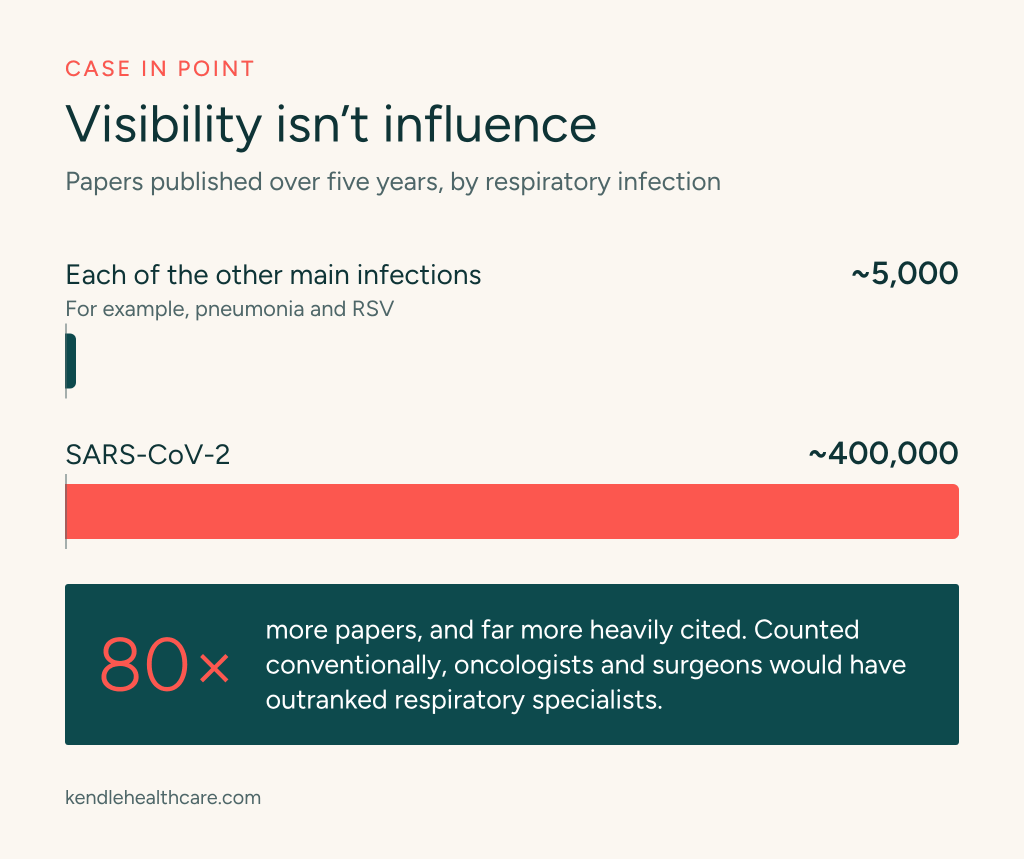
That created a problem. Oncologists, surgeons and critical care specialists published on SARS-CoV-2, often repeatedly, because it was the biggest story in their own fields, and their papers attracted vast numbers of citations. Counted conventionally, they would have outscored respiratory specialists whose research focused on pneumonia and RSV. Yet excluding SARS-CoV-2 wasn’t an option either. It was the most important topic in respiratory infection at the time, and many genuine experts were publishing on it.
The solution had two parts: we created two publication scores, one including the SARS-CoV-2 papers and one excluding them, and we compared the two when curating the final list of KOLs.
The wider principle
The lesson isn’t simply to watch out for distortions. It’s that the markers of influence, and how much weight each one carries, should be different in every project.
Take guidelines. In some disease areas, guideline authorship is a strong marker of influence. But if the guidelines are very old, are out of date almost as soon as they’re published, or simply aren’t followed in practice, authorship may tell you much less.
The same applies to publications. In a disease area with relatively few papers, research from ten years ago may still be important, because you need a large enough body of scientific literature to analyse. In an area with tens of thousands of papers a year, five years may give you more than enough data, and going further back risks ranking people for research that is no longer relevant.
A method that works well in one disease area can mislead in another. Prominence is easy to measure. Relevance must be worked out, project by project.
Five questions to ask before you rely on your list
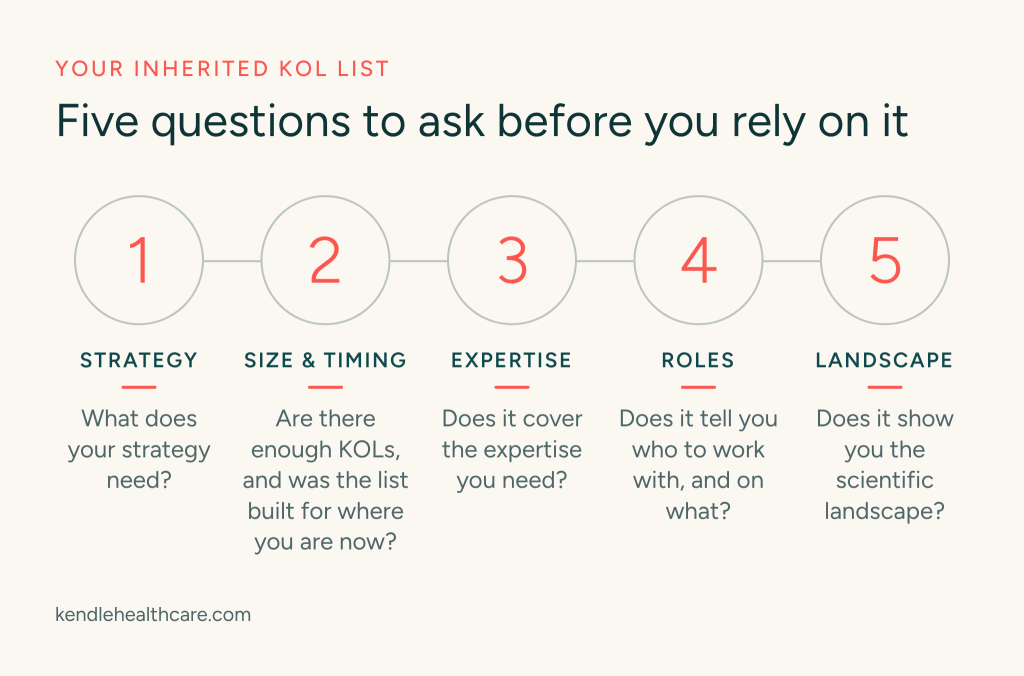
None of this means your inherited list is worthless. It means it should be assessed before it shapes your engagement. These are the five questions we’d ask.
1. What does your strategy need?
Start with the strategy, not the list. What must KOL engagement help you deliver? Which types of KOL, and which knowledge and expertise, does that require? Until you’ve answered this, you have nothing to measure the list against.
2. Are there enough KOLs, and was the list built for where you are now?
You need to know more KOLs than you will actually work with, partly to give yourself choice, and partly because some won’t be available. And if your list will also be used in individual markets, does it include the national and regional experts those teams need?
It’s also worth checking when the list was built, and for what. Up-to-date profiles aren’t the same as an up-to-date selection. If your strategy has moved on since the list was created, perhaps into a new phase, a new indication or new markets, or if the field has changed with new guidelines or new treatments, important people may be missing. You may also find you’re working with people who no longer set the agenda, or who are no longer suitable for your needs.
3. Does it cover the expertise you need?
Between them, the KOLs on your list should carry the expertise and insight your strategy needs from KOL engagement. Map the list against those needs.
Getting this right matters. We worked on one project where the product would be used to treat a serious condition, but the client’s forecast showed far greater use as a prophylaxis. Most of the KOL engagement therefore needed to be with experts in the patients at risk, not with experts in treating the condition itself. It would have been easy for our client to focus their engagement on KOLs in the condition, rather than on the KOLs who mattered.
Of course, this is an extreme example. More often, the most prominent KOLs in the disease area cover most of what you need. That’s the 80% your list probably already includes. The risk lies in the other 20%: the expertise and insight your strategy depends on that the obvious names can’t provide.
Whatever your strategy, the test is the same: does the list include the people who can give you the knowledge and insight you need to achieve it?
If they’re there, the next question is whether you can tell which KOLs they are, and what each one can offer.
4. Does it tell you who to work with, and on what?
A list of names isn’t a plan. Faced with a long list of experts you don’t know personally, the natural thing is to start with the highest-scoring KOLs and work down. But a high score tells you who is prominent, not who is right for a particular activity. Without personal knowledge of the KOLs, deciding who to involve in what can end up close to arbitrary.
Data platforms can tell you a lot about each KOL: their research interests, how often they present, how active they are. But those are generic measures, the same for every company that looks them up. What matters is whether you can see which KOLs are interested in the specific topics your strategy depends on, and which activities each one is best suited to.
Your list should also make clear why each KOL is on it. For every name, you should be able to answer two questions: why does this KOL matter to your strategy, and where do they fit in your plan? If the list makes that clear, your team doesn’t have to guess who to invite to an advisory board, or who to ask for insight into a particular mechanism of action. That’s what turns a list into a plan.
5. Does it show you the scientific landscape?
A list tells you who. The landscape shows you how influence works.
Do you know who connects different specialties, and whose views others follow? Which societies, meetings and working groups really matter, including some that never appear online? Whether specialties work together or in silos, and how KOL communities differ from country to country? What the community thinks about upcoming treatments, and what experts believe most needs to improve in the field?
You don’t always need this. For a one-off activity, such as a single advisory board, a well-chosen list may be enough. But in a long-term programme, this context is often the difference between good KOL engagement and excellent engagement. It helps you engage experts on the issues that matter to them, and it helps your team take part in the scientific community, not just observe it from the outside.
Answering these questions doesn’t necessarily mean starting again. Often it simply shows you where the gaps are, and what you need to fill them.
Built for everyone, or built for you?
Underlying all five questions is a more fundamental difference: whether a list was generated generically or built for your strategy.
A list generated by a data platform or an AI tool usually ranks experts by prominence and publication volume. It draws on the same data your competitors use. It shows you who is visible rather than who is relevant, and it shows individuals, not how influence works between them. Because it scores every disease area the same way, anomalies such as publication spikes can go unchecked.
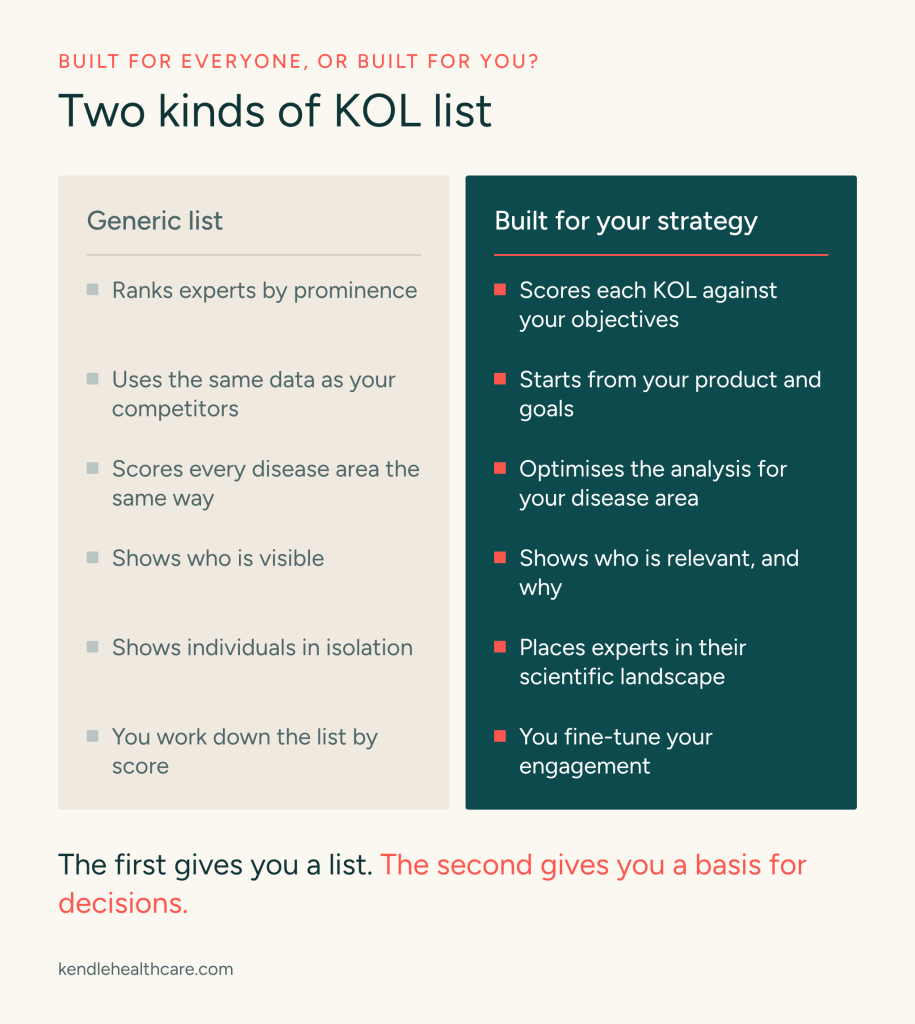
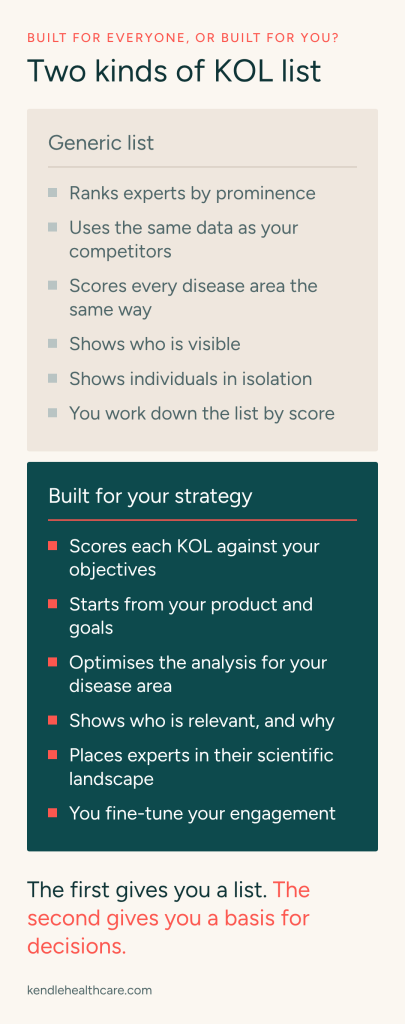
Strategic KOL identification and mapping works the other way round. It starts from your product, your disease area and your objectives, and scores each KOL against them. The analysis is optimised for each disease area, so anomalies don’t skew the results. It shows you who is relevant and why. And it places each expert in the context of the wider scientific landscape.
The difference shows in the engagement itself. With a generic list, you’re working with around 80% of the right people, and even then not always on the right things: the highest-scoring KOLs get asked to do everything, and the rest is guesswork. With a list built for your strategy, you can see which KOLs to engage, for which activities and which insight. Instead of working down a list by score, you can fine-tune your engagement to what your strategy needs.
The first gives you a list. The second gives you a basis for decisions.
Start with your strategy
An inherited KOL list can be a useful resource. But it was built for someone else’s priorities, at a particular point in time, and probably with a method that wasn’t designed around your goals.
So don’t start with the list you inherited. Start with your strategy, and then ask whether the list is fit for it.
If you’re unsure whether yours is, we’re happy to give a second opinion.
Recent Posts
- You’ve inherited a KOL list. Is it built for your strategy? November 20, 2026
- Kendle Healthcare climate targets validated by Science Based Targets initiative (SBTi) October 19, 2026
- Opinion Leadership Demystified: Transformational Knowledge For Every Industry in 2026 June 15, 2026
- Mastering Open and Honest KOL Communication: The Cornerstone of Effective KOL Engagement June 15, 2026
- The Ultimate KOL Networking Guide: Mastering KOL Engagement at Conferences (2026) June 15, 2026