Mastering Open and Honest KOL Communication: The Cornerstone of Effective KOL Engagement
In our recent survey of Key Opinion Leaders (KOLs), we asked what they considered most important in an effective working relationship with the pharmaceutical industry.
The consensus was unequivocal: KOLs overwhelmingly ranked “open and honest” interactions as the most important attribute, with “good communication” in third place.
This finding forms the starting point of our exploration into the importance of open and honest KOL communication for effective KOL engagement.
What do we mean by “open and honest” KOL communication?
A lack of openness can take different forms: withholding information that a KOL would reasonably expect to know, approaching a conversation with an objective that you haven’t made clear, or avoiding an honest explanation about why a KOL isn’t suitable for a particular activity.
The Benefits of Open and Honest KOL Communication
1. It builds trust
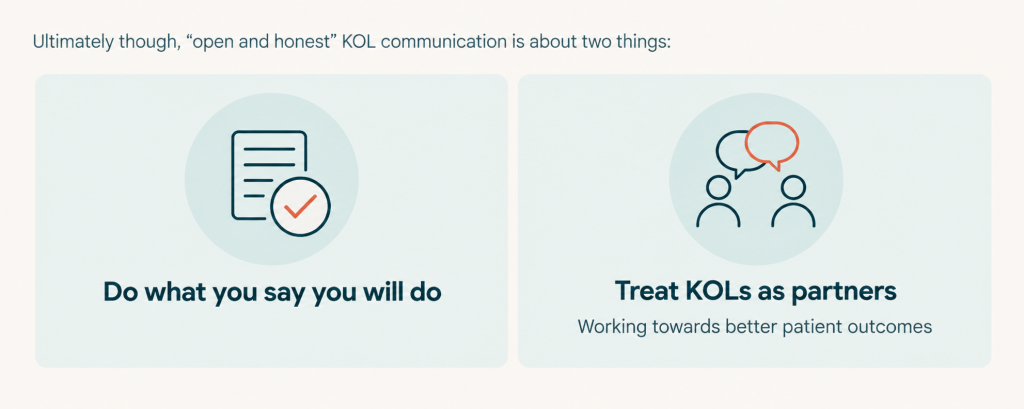
KOLs need to trust that you will do what you say you will do, and that you will be straightforward with them when circumstances change. In turn, that trust makes it easier for KOLs to tell you things you may not want to hear, but need to know.
2. It leads to better engagement
KOLs are more likely to engage openly when they believe their expertise is genuinely valued and that the relationship is based on mutual respect. This creates better conversations and gives both parties a clearer understanding of what the other is trying to achieve. Understanding the KOL’s point of view is therefore an important part of building an effective relationship.
3. It leads to more useful insight
The value of engaging a KOL lies partly in hearing perspectives that you don’t already have. An open relationship makes it easier for KOLs to challenge assumptions, raise concerns and offer ideas rather than simply telling you what they think you want to hear.
Navigating Challenging KOL Communication Scenarios
Open and honest communication is not always easy. It matters most when the conversation is difficult.
The Funding Request
A KOL approaches you seeking funding for an educational initiative they are closely involved with. You can see the value of the project and believe it aligns with your company’s objectives, but when you submit the funding request internally, it is declined.
You now have to tell the KOL. It may be tempting to delay the conversation or soften the message, particularly if you are concerned that the decision could damage the relationship. But avoiding the conversation is likely to make matters worse.
How to handle it
- Tell them promptly. Don’t leave the KOL waiting or risk them hearing the decision from somebody else.
- Tell them personally. Where you have an established relationship, a phone or video call is usually more appropriate than an impersonal email.
- Be clear about what happened. Acknowledge their disappointment and explain the decision as openly as you reasonably can. Don’t imply that you supported the decision if you didn’t.
When a KOL Isn't the Right Fit
A local KOL with whom you have worked regularly asks to give presentations on behalf of your company. You value the relationship, but when you consider them alongside other potential speakers, you don’t think they are currently the right person for the role.
This is a more difficult conversation because the decision reflects, at least in part, your assessment of the KOL. But avoiding an honest answer risks creating confusion and damaging the relationship.
How to handle it
- Don’t avoid the conversation. If the KOL has asked directly, they deserve a clear response.
- Be honest but constructive. Explain the factors that influenced the decision without being unnecessarily critical.
- Discuss development where appropriate. If there are specific areas that would make the KOL a stronger candidate in future, and you can genuinely help with them, discuss those openly.
Open and honest communication is relatively easy when the message is positive. It matters most when it isn’t. KOLs may not always welcome a decision, but explaining it promptly, personally and honestly demonstrates respect for both the KOL and the relationship.
Conclusion
Our survey found that KOLs value open and honest communication in their relationships with industry. That sounds obvious but it becomes more difficult when the message you have to deliver isn’t the one a KOL wants to hear.
Being prompt, clear and honest in those situations demonstrates respect for the KOL and helps build the trust on which effective long-term relationships depend.
Recent Posts
- Kendle Healthcare climate targets validated by Science Based Targets initiative (SBTi) October 19, 2026
- Opinion Leadership Demystified: Transformational Knowledge For Every Industry in 2026 June 15, 2026
- Mastering Open and Honest KOL Communication: The Cornerstone of Effective KOL Engagement June 15, 2026
- The Ultimate KOL Networking Guide: Mastering KOL Engagement at Conferences (2026) June 15, 2026
- Transform KOL Relationships and Engagement: Embracing the KOL Point of View in 2026 January 27, 2025